South Florida
When Your Son's Bris Falls on Rosh Hashanah
By Rabbi Yossi Srugo | Miami Mohel | miamimohel.com
September 10, 2026
The shofar sounds.
The world holds its breath.
And somewhere in South Florida, a family counts forward eight days from their son's birth — and realizes the date lands on Rosh Hashanah.
For most parents, the first reaction is a question: does the bris still happen?
The answer is yes. And once you understand why — and what it means — that yes becomes one of the most profound gifts a Jewish family can receive.
The Halacha: A Brit Milah on Rosh Hashanah
Rosh Hashanah is a Yom Tov — a major Jewish holiday — and like most Yom Tovim, it does not stop a timely Brit Milah.
The Torah is clear: a Brit Milah performed on its proper eighth day takes precedence. The bris happens. The mohel performs the ceremony within the specific halachic parameters of Yom Tov, with all preparations completed in advance, and the covenant is fulfilled on the day it was ordained.
This is not a leniency or a special dispensation. It is simply the law — and it has been practiced by Jewish families for thousands of years.
What changes is the preparation and the intention behind it. What doesn't change is the ceremony, the blessings, the Hebrew name, the simcha, and the meaning.
Two Signs. One Day.
Here is where the halacha becomes something much deeper.
In Jewish thought, both Rosh Hashanah and the Brit Milah are described by the same word: ot — a sign. A mark of the covenant between the Jewish people and G-d.
Shabbat is an ot. The Brit Milah is an ot. And Rosh Hashanah — the day the world was created, the day all souls stand before the King — is the ot of beginnings.
When your son's bris falls on Rosh Hashanah, two of the most sacred signs in Jewish life converge on the same morning. The covenant of the body. The covenant of the year. Both witnessed by the same family, in the same room, before the same G-d.
There is no coincidence in the Jewish calendar.
Hayom Harat Olam — Today the World Was Born
During the Rosh Hashanah davening, at the moment the shofar is sounded, the congregation says:
"Hayom harat olam" — Today the world was conceived. Today creation itself began.
Now imagine standing in that same Rosh Hashanah morning — having just heard those words in shul — and watching your son enter the covenant of Avraham Avinu.
Today the world was born. And today, your son was born into his people.
The timing is not a complication. It is a commentary — written by G-d Himself — on who your son is and when he arrived.
The Hebrew Name on the Day of Judgment
On Rosh Hashanah, Jewish tradition teaches that every soul passes before G-d. Every name is written. Every life is weighed.
At a Brit Milah, the baby receives his Hebrew name for the first time — spoken aloud, over wine, in front of family and community, in the presence of Eliyahu HaNavi.
When those two moments collide — the Hebrew name given on the very day names are written in the Book of Life — the room understands something that doesn't need to be explained.
It is simply felt.
What I Do Differently
A Rosh Hashanah bris requires a mohel who knows not just the halacha of Brit Milah, but the halacha of Yom Tov. Who has done this before. Who arrives with everything prepared, nothing left to chance, and enough experience to hold the ceremony with the gravity the day demands.
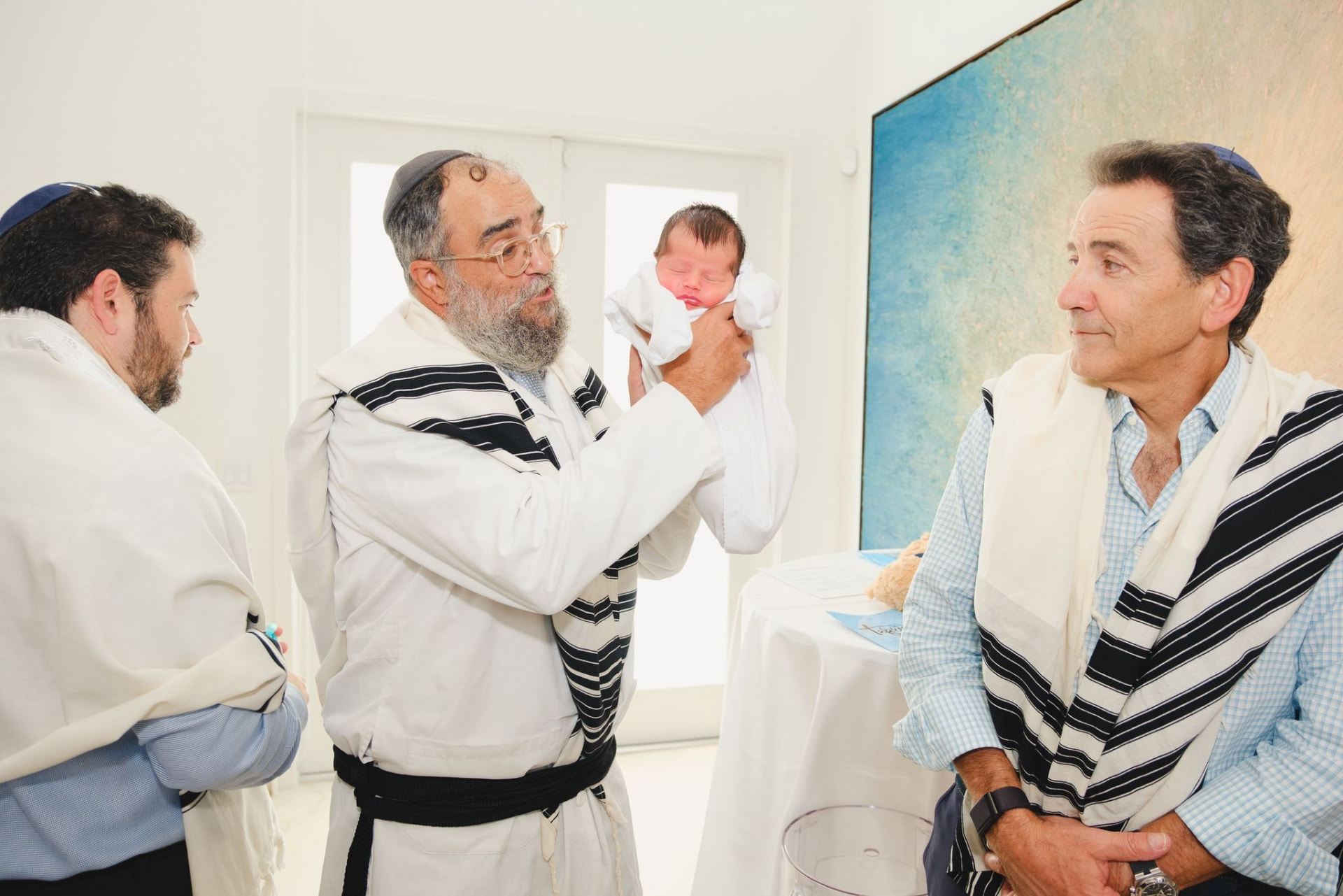
After 19 years and more than 6,000 brisses across South Florida, Rabbi Yossi Srugo has performed Brit Milah on Rosh Hashanah, Yom Kippur, Shabbat, and every major holiday on the Jewish calendar.
He prepares the family in the week leading up to the bris — walking them through the ceremony, the family honors, the order of the day. He coordinates the timing around davening and the shofar blowing. He arrives early, sets up completely, and ensures that when the moment comes, the only thing the family has to do is be present.
And when it's over — when the baby is calm and the room is full of simcha — he stays. He holds your son. He guides the recovery. He answers every question in the days that follow.
Because a Rosh Hashanah bris is not a logistical challenge to be managed.
It is a once-in-a-generation moment to be honored.
A New Year. A New Soul. A New Covenant.
Every Rosh Hashanah, we ask G-d for a year of life, of health, of meaning.
If your son's eighth day falls on Rosh Hashanah, you are not just asking for that year.
You are beginning it — with the most ancient Jewish act of commitment there is. Welcoming your son into the covenant on the day the world renews itself. Giving him his name on the day names are written. Bringing him before G-d on the day all of Israel stands before G-d together.
L'dor vador — from generation to generation.
It doesn't get more Jewish than this.
Shanah Tovah — and Mazel Tov
If your son was born in the days before Rosh Hashanah 5787, and you're calculating that eighth day right now — reach out to Rabbi Yossi directly.
He will walk you through everything. The halacha, the logistics, the meaning. The first conversation is always free, always personal, and always without pressure.
Because this is not just a bris.
This is the beginning of everything.
Rabbi Yossi Srugo is a Board Certified and Rabanut Certified Mohel serving Jewish families across Miami-Dade, Broward, and Palm Beach County. He performs Brit Milah in Ashkenazic and Sephardic traditions, in Hebrew, English, and Spanish.